1.Circular List
A Circular list , has the next of last node pointing towards the first node of the list , so in algo terms :
rear->next =front;

This forms a circle of nodes as now last node and first node is connected , just like a circle :
Now why Circular Link list , as you might have noticed when you pop a value the memory of the element goes waste , until an unless you free the memory location , So to counter this we use circular List .
Class’s look like ,
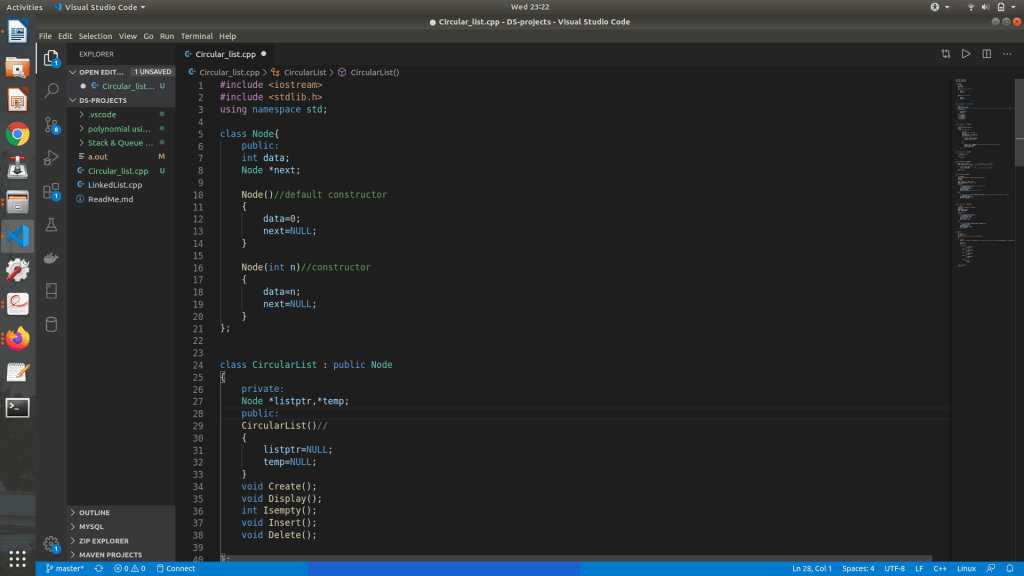
Code is going to be similar to linked list , except the condition to iterate through the list, we can’t use NULL as there will not be a NULL Value , so we use last ptr or listptr , it point as the last node .
void CircularList :: Create()//Same as Linked list
{
    int i, n;
    cout<<"\n How many nodes :";
    cin>>n;
    for(int i=0; i<n; i++)
        {
            int num;
            cout<<"\n Enter the data :";
            cin>>num;
            Node *newnode = new Node(num);
            if(listptr == NULL)
            {
                listptr = temp = newnode;
                newnode->next=listptr;//for last node to point to first node
            }

            else
            {
                temp -> next = newnode;//temp currently points towards current block
                newnode->next=listptr;//for last node to point to first node
                temp = temp->next;
            }
        }
}

void CircularList:: Display()
{
    Node * temp = listptr ;         /*    temp points to first node*/
    while (temp->next != listptr) //iterate till it reaches last block
    {
         cout << temp->data << "--->";
         temp = temp->next;         /*    move temp to the next node */
    }
    cout<< "END";

}

void CircularList::Insert()
{
    int num,pos;
    cout<<"Enter number to input followed by position";
    cin>>num;
    cin>>pos;

    Node *newnode= new Node (num);
    Node *temp=listptr;//value of head
    if(pos==1)//first node
    {
        while (temp->next!=listptr)//to reach last node
            temp=temp->next;
        newnode->next=listptr;
        listptr=newnode;
        temp->next=newnode; //link last to first
    }
    else
    {
        for (int i = 1; i < pos-1 &&temp->next!=listptr; i++)//reaching till the location to insert ,
            temp=temp->next;
        newnode->next=temp->next;
        temp->next=newnode;

    }

}

void CircularList :: Delete()
{
    int pos;
    cout<<"Enter  position to delete" ;
    cin>>pos;
    Node *temp= listptr;
    Node *temp1=temp;

    if(pos == 1)
    {
        while (temp1->next!=listptr)
            temp1=temp1->next;
        listptr=listptr->next;
        delete temp;
        temp->next=listptr;
    }
    else
    {
        for (int i=1;i<pos-1 && temp->next !=listptr;i++)
            temp=temp->next;
        temp1=temp->next;
        temp->next=temp1->next;
        delete temp1;
    }
}
2.Doubly Linked list :
A Doubly Linked list , is a simple linked list which also contains address of it’s previous node , So we can iterate to both side while iterating ,

When we reverse a Link list it takes a lot of computational power , just to reduce it we take prev as well as next address values , for easy iteration .

Now class’s are going to be similar , but will contain an extra variable in class Node , Node *prev,
A.Here you can Insert a node in three Scenarios ,
1.At beginning

    int ele;
    cout<<"\n Enter an element ";
    cin>>ele;
    Node *newnode = new Node(ele);
    newnode->next=lp;
    lp->prev=newnode;
    lp=newnode;
    return lp;
2.At Middle

Node *current_node=lp;
    int count=1;

    while (current_node->next!=NULL)
    {
        if(count==pos)
        {
            int ele;
            cout<<"\n Enter an element ";
            cin>>ele;
            Node *newnode = new Node(ele);
            newnode->next=current_node->next;
            current_node->next->prev=newnode;
            current_node->next=newnode;
            newnode->prev=current_node;
            break;
        }
        else
            count+=1;

        current_node=current_node->next;
    }
3.Insert at END

 Node *current_node=lp;
    while (current_node->next!=NULL)
        current_node=current_node->next;
    int ele;
    cout<<"\n Enter an element ";
    cin>>ele;
    Node *newnode = new Node(ele);
    newnode->next=NULL;
    current_node->next=newnode;
    newnode->prev=current_node;
B.You can delete node in three scenarios ,
1.Deleting first node

 if(lp==NULL)
        cout<<"\n List is Empty";
    else
    {
        Node *tempo=lp;
        lp=lp->next;
        free(tempo);
        return lp;
    }
2.Deleting Middle node

 if(lp==NULL)
        cout<<"\n List is Empty";
    else
    {
        Node *current_node=lp;
        int count=1;

        while (current_node->next!=NULL)
        {
            if(count==pos)
            {
                Node *tempo;
                tempo->prev->next=tempo->next;
                tempo->next->prev=tempo->prev;
                free(tempo);
                break;
            }
            else
                count+=1;

            current_node=current_node->next;
        }

    }
3. At the last node

 if(lp==NULL)
        cout<<"\n List is Empty";
    else
    {
        Node *current_node=lp;
        while ((current_node->next)->next!=NULL)
            current_node=current_node->next;
        Node *tempo=current_node->next;
        current_node->next=NULL;
        free(tempo);
    }
}
GitHub code :https://github.com/kakabisht/Data-structures

 Programmer Prodigy
One thought on “Types of Lists :”